Sunday, June 27, 2010

Sex on the Rocks

I got this set of pictures four years ago during a weekend in Gozo with my family. We were visiting a small freshwater pool at Dwejra. My intention was to take some photos of damselflies and dragonflies but as happens often in nature photography I ended up taking pictures of something totally unexpected.

I saw this beautiful male lizard sunning himself on top of a boulder. It looked tame and I moved close to it to get some pictures. Lizards on Gozo are tamer than those on Malta and I managed to get some beautiful closeups.


Half way through the photo session he was distracted by a female lizard that was passing by in the vicinity. He looked only once (it must have been love at first sight) and he left his boulder to follow her.


When he reached her he placed himself in front of her and started to show off his bright yellow throat. She must have been impressed by his display because she slowed down her pace.

When she passed by he ran after her and caught the tip of her tail in his mouth. She seemed to be ignoring him and continued walking. Sometimes he held placed his front leg on her tail to slow her down.


He then moved his mouth, one small bite at a time, towards the front part of the tail and beyond and continued until he was holding her from the abdomen.


While this was going on he was oblivious to the fact that I was taking pictures and three other people including two noisy young girls were watching him closely.


He then entwined himself around the female and twisted himself so that their genital organs were touching. He remained in this position for several seconds. When they were ready she continued walking in the original direction and he went back to his boulder.

The whole photo session took about five minutes but the actual courtship and copulation lasted less than a minute.

I had never seen this behaviour before and I have not seen it since even though I spend many hours every week in the countryside. One might call it luck but if you spend enough time out in nature you are bound to meet interesting situations.

Thursday, June 24, 2010

Homemade Yoghurt

Yoghurt tastes good and is said to be a very healthy food. At home everybody loves it. Up to the end of last year we were consuming so much that that we were ending up with piles of plastic containers. I used some of them as pots for vegetable seedlings but at the end the pots still had to be thrown away. Furthermore buying so much yoghurt was expensive so I decided to try my hand at making my own yoghurt.

I found several websites with instructions for making yoghurt but they all required sophisticated equipment. I had no intention of spending money on such things but I found out that the principle for making yoghurt is very simple and once I understood that I realised that it was possible to make yoghurt very easily. Now I have been making my own yoghurt for more than six months.

Yoghurt is milk fermented by a certain kind of bacteria. The bacteria multiplies and does its work at a certain temperature and it does not like competition so no other bacteria is to be allowed in the milk during the fermentation.

These are my instructions for making home-made yoghurt:

Get a 1 litre glass jar with a tight-fitting lid and clean it thoroughly. Boil a little water in a small pan, pour the boiling water in the jar, put the cap on and shake it well to sterilise the jar. Throw the water away and pour small fresh plain yoghurt in it (one small container is enough). Warm a little less than 1 litre of long-life milk in the pan. The milk should be at a temperature between 43 and 45 degrees. I never use a thermometer for this -I touch the pan and when it is just about to become too hot to touch I remove it from the fire. Pour the milk into the jar, close the lid and shake it well. Remove the lid and place the jar in a warm place. I place it in the (electric) oven which has a very good insulation. Place a kettle full of boiling water in the oven. This will keep the oven at the right temperature. The yoghurt is ready six or eight hours later. Warm yoghurt is fantastic but it does not keep long so just close the lid and place in the refrigerator. The yoghurt should last for several days. I have never tested this because it always finishes in a very short time.
My method is very unconventional but somehow I always got it right. The milk used does make a difference. Full milk tastes better but is more fattening. Long-life milk gives better results. If you use the normal pasteurised milk I think you would have to heat it to a higher temperature and allow it to cool which I never do because I do not use a thermometer.

Once you have your first batch of yoghurt you can keep some for the next lot. To save time and energy I now produce two litres of yoghurt at a time and instead of boiling water in a kettle I time the process with the cooking of a pasta dish. I pour the boiling pasta water into another pan and use it to warm the oven.

I calculated that I am saving about Euro 200 per year and all it takes is about 5 minutes per week and a little planning.

Tuesday, June 22, 2010

Thursday, June 17, 2010

Dragonflies are beautiful

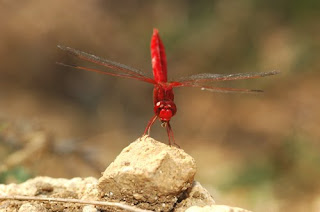
Dragonflies are my favourite insects. They are fast, agile, colourful and have an interesting life-cycle. Despite the fact that in Malta we do not have many areas with aquatic habitats one can find a good number of species. The commonest is the scarlet darter which can be seen throughout summer wherever there is fresh water. It does not need large amounts of water and is quite happy near a drinking trough or garden pond.

Scarlet Darter

Dragon flies are voracious predators. They hunt smaller insects such as mosquitoes. They chase them and catch them in their front legs. They are extremely agile and have very good sight- their wings and eyes are in fact their most characteristic features.

Male Emperor Dragonfly


Wednesday, June 16, 2010

Pesticide-free Strawberries


Some years ago I bought some beautiful strawberries from a van at Mosta. After paying for them I popped one in my mouth and as I did so the lady who sold them to me screamed for me to stop.

Too late.

I had already bitten through it and realised that it had such a very bitter taste that I had to spit it out. I asked the lady whether the strawberries had just been sprayed with pesticide and she vehemently denied saying that her husband never sprays the strawberries but insisted that I should wash them thoroughly before eating them.

There is no need for pesticides but farmers have been brainwashed. They are convinced that without pesticides they would not be able to grow any vegetables. But their parents did not have pesticides and organic farmers are managing as well. I also can also confirm this because during the past three years I have grown vegetables on my roof without using pesticides.


Tuesday, June 15, 2010

Rooftop onions

A couple of days ago I harvested my first onions. I have neither field nor garden so I have to make do with growing vegetable on my roof. Three summers ago I started with a couple of cherry tomato plants. The following summer I increased the number of pots and containers and grew cucumbers, tomatoes, lettuce, beans red and yellow bell peppers, aubergines and strawberries. During that summer we had a homegrown salad every day. After summer I planted winter vegetables which included cauliflowers, broccoli, purple cabbage, onions, garlic, kohlrabi etc. I also planted about 30 strawberry plants which I had propagated from the three original plants I had in summer.
This spring we are already preparing salads using lettuce, cucumber and cherry tomatoes. In a few weeks time I should be harvesting more vegetables every day and I am already thinking about what I will be planting next autumn.

Friday, June 11, 2010

The caper flower


Last Sunday as I was taking pictures I decided to collect some capers from the plants that grow on the walls along the road at Chadwick Lakes. I was not the only person picking capers but I was probably the only one who looked closely at the flowers of this common plant. Perhaps it is the photoagrphy which makes me see things that others often fail to see as we have a tendency to overlook common and familiar objects, especially if they have a utilitarian value. The flower of the caper is one of them as although it is extremely common throughout the Maltese islands, few people are able to describe its flowers in any detail. Five minutes of close observation is all it takes to discover the delicate beauty of this ubiquitous flower.
The caper is a common plant found growing out of cliff faces and rocky habitats throughout the Mediterranean. It is also found on stonewalls and bastions which to the caper plant, are the same as a cliff face.
It grows in the form of a bush with fleshy round leaves which fall off during the winter months. Large white flowers, which can be up to six centimeters in diameter, appear between May and July.