 Can somebody organise a course in basic ornithology?
Tuesday, June 22, 2010


Thursday, June 17, 2010
Dragonflies are beautiful
Dragonflies are my favourite insects. They are fast, agile, colourful and have an interesting life-cycle. Despite the fact that in Malta we do not have many areas with aquatic habitats one can find a good number of species. The commonest is the scarlet darter which can be seen throughout summer wherever there is fresh water. It does not need large amounts of water and is quite happy near a drinking trough or garden pond.
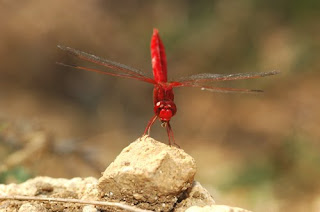 Scarlet Darter
Dragon flies are voracious predators. They hunt smaller insects such as mosquitoes. They chase them and catch them in their front legs. They are extremely agile and have very good sight- their wings and eyes are in fact their most characteristic features.
Male Emperor Dragonfly
Wednesday, June 16, 2010
Pesticide-free Strawberries

Some years ago I bought some beautiful strawberries from a van at Mosta. After paying for them I popped one in my mouth and as I did so the lady who sold them to me screamed for me to stop.
Too late.
I had already bitten through it and realised that it had such a very bitter taste that I had to spit it out. I asked the lady whether the strawberries had just been sprayed with pesticide and she vehemently denied saying that her husband never sprays the strawberries but insisted that I should wash them thoroughly before eating them.
There is no need for pesticides but farmers have been brainwashed. They are convinced that without pesticides they would not be able to grow any vegetables. But their parents did not have pesticides and organic farmers are managing as well. I also can also confirm this because during the past three years I have grown vegetables on my roof without using pesticides.
Tuesday, June 15, 2010
Rooftop onions
 A couple of days ago I harvested my first onions. I have neither field nor garden so I have to make do with growing vegetable on my roof. Three summers ago I started with a couple of cherry tomato plants. The following summer I increased the number of pots and containers and grew cucumbers, tomatoes, lettuce, beans red and yellow bell peppers, aubergines and strawberries. During that summer we had a homegrown salad every day. After summer I planted winter vegetables which included cauliflowers, broccoli, purple cabbage, onions, garlic, kohlrabi etc. I also planted about 30 strawberry plants which I had propagated from the three original plants I had in summer.
 This spring we are already preparing salads using lettuce, cucumber and cherry tomatoes. In a few weeks time I should be harvesting more vegetables every day and I am already thinking about what I will be planting next autumn.
Friday, June 11, 2010
The caper flower

Last Sunday as I was taking pictures I decided to collect some capers from the plants that grow on the walls along the road at Chadwick Lakes. I was not the only person picking capers but I was probably the only one who looked closely at the flowers of this common plant. Perhaps it is the photoagrphy which makes me see things that others often fail to see as we have a tendency to overlook common and familiar objects, especially if they have a utilitarian value. The flower of the caper is one of them as although it is extremely common throughout the Maltese islands, few people are able to describe its flowers in any detail. Five minutes of close observation is all it takes to discover the delicate beauty of this ubiquitous flower.
The caper is a common plant found growing out of cliff faces and rocky habitats throughout the Mediterranean. It is also found on stonewalls and bastions which to the caper plant, are the same as a cliff face.
It grows in the form of a bush with fleshy round leaves which fall off during the winter months. Large white flowers, which can be up to six centimeters in diameter, appear between May and July.
The caper is a common plant found growing out of cliff faces and rocky habitats throughout the Mediterranean. It is also found on stonewalls and bastions which to the caper plant, are the same as a cliff face.
It grows in the form of a bush with fleshy round leaves which fall off during the winter months. Large white flowers, which can be up to six centimeters in diameter, appear between May and July.
Thursday, June 10, 2010
The wild artichoke

The wild artichoke has several English names. This is probably because it is edible and has medicinal properties. It is known as the artichoke thistle, cardoon, cardone, cardoni, carduni or just cardi. In Maltese it is known as qaqoċċ tax-xewk but probably in different parts of the Maltese islands it has other names as well. It is the wild variety of the cultivated globe artichoke, what we in Malta know as qaqoċċ.
Wild artichoke is common in clayey areas and disturbed ground especially abandoned fields and roadsides. It is recognized by the large spiny leaves and also by the large bluish flowers. They appear from late spring to early summer so now is the time to go and look for them. There are many growing along the road that runs along the valley leading to and from Chadwick Lakes. You can get there either by going down a steep hill that starts from Rabat or else through a narrow road outside Mosta on the way to Rabat. The flowers resemble large blue-purple thistles. If you look into the flowers you should be able to find many small insects especially beetles.
The wild artichoke grows up to one metre high. The cultivated variety can grow up to two meters but I have not seen any higher than a metre in Malta. The globe artichoke is now grown widely especially around the Mediterranean.
About twenty five years ago I was watching birds of prey migrating at Cap Bon in Tunisia and the guard of the nature reserve shared his dinner with us. It consisted of a meat stew with the thick central part of the leaves of the wild artichoke which grows abundantly in the area. I have been thinking of trying the recipe since then but spring comes and goes and I have not yet got around to collecting some leaves. I will try to do it next spring when the leaves are at their best and I promise to write about it in this blog.
My Blogs
 I have been writing about nature and the environment since I was in my teens. I wrote my first articles for the newsletter of the youth members section of the Malta Ornithological Society. When I started working I used my first salary to buy a camera and immediately started taking pictures, mostly of plants, animals and landscapes. After some time I started using these photos to illustrate my articles and I have not stopped writing and taking pictures.
In 1996 I started writing weekly articles about nature in the Times of Malta. The articles are still appearing every Wednesday in the Times. This blog will compliment these articles. Those who not read my articles in the Times have an opportunity to read my work here and those who like reading my Times articles should visit this blog as what I will be writing will be be complimenting these articles.
I hope you enjoy reading these blogs as much as I enjoy writing and photography.
Paul
Subscribe to:
Posts (Atom)

